
One Zellige Pattern, Many Hands: The People Behind a Moroccan Mosaic
IN THIS GUIDE
The People Behind Every Mosaic in Morocco
A square of tilework can preserve part of a home’s story long after leaving its walls. One Moroccan zellige panel recorded in the Batha Museum collection in Fes came from a local house, was salvaged, and entered the museum in 1945. At its centre is a twelve-pointed star. Around it, coloured lines cross and repeat, holding a complicated design together.
The Museum With No Frontiers catalogue dates the panel to the nineteenth century. It records its materials and origin, but does not identify its makers. We can describe the object more easily than we can recover the lives of the people who shaped it.
That gap invites a different way of looking. Behind a Moroccan mosaic are people who prepare the material, refine the shapes, understand the pattern and bring its parts together. Following those skills helps us see both the beauty of zellige and the work a finished surface can conceal.
What is Moroccan zellige?
Moroccan zellige is glazed clay tilework, especially associated with mosaics assembled from individually cut pieces. You may also encounter the spellings zellij and zillij. In a geometric panel, the shapes themselves create the design; the pattern is not simply printed across a flat surface.
Look at a mosaic from several steps away and you notice its overall rhythm. Move closer and individual pieces emerge: a star, a narrow band, a small polygon tucked between larger forms. Each belongs to a relationship with its neighbours. The pattern depends on those relationships being carried through the whole surface.
The historic Batha panel offers a specific example. Its catalogue describes black and turquoise-blue knotwork against ivory, with additional ochre and green elements. That is evidence about this particular object, rather than a colour rule for every Moroccan mosaic.
The people behind the finished surface
There is no fixed number of makers behind every panel. A small atelier may combine several roles, while a larger project can divide the work among specialists. What matters is the connection between the tasks: material prepared at one stage must be suitable for the next.
The people who prepare the tiles
Before a mosaic has a recognisable pattern, it needs ceramic material. Clay is formed into tiles, dried and fired; glazing gives the visible face its colour and finish. Producers such as Zia Tile describe the hand shaping and kiln firing behind their Moroccan tiles, including the variations in shade and thickness that result.
This makes the plain tile worth a second look. It already contains work, even before anyone cuts a star from it. In a studio visit, ask to see the material at different stages. Comparing an unfinished tile with a glazed one makes preparation easier to understand than looking only at the completed wall.
The person who plans the pattern
Someone must work out how the design occupies its space. Where does the repeat begin? How does the border meet it? Which shapes are needed, and in what colours? These are practical decisions as well as visual ones. A beautiful central motif still needs to connect successfully with the rest of the panel.
Try tracing a single band with your eye. Follow it through one crossing and into the next. You begin to notice the planning that allows a complicated surface to feel coherent.
The hands that turn a tile into a shape
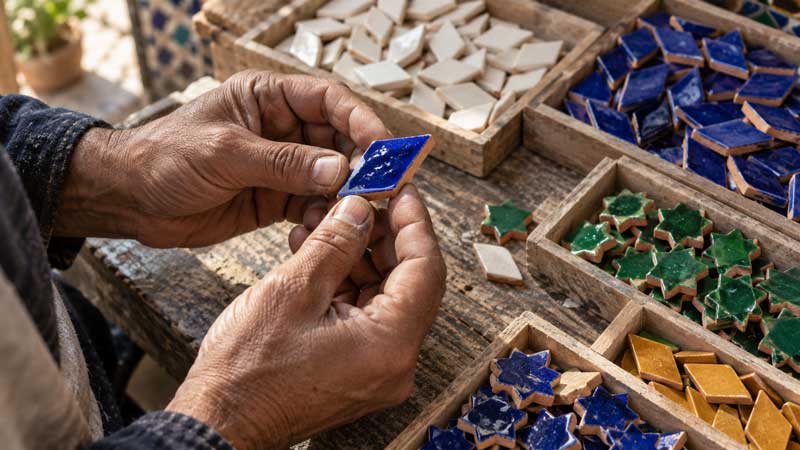
For traditional cut-tile mosaics, an artisan shapes glazed ceramic into the pieces the design requires. A specialised cutting hammer, often transliterated as menqach, appears in accounts of the craft. The aim is to produce a piece whose outline will meet the surrounding pieces accurately.
The distinction between a recognisable shape and a usable piece is important. A triangle can look convincing on its own yet fail to fit its intended space. Think of the cutter’s task as a relationship with the future assembler: each edge must work beyond the piece in front of them.
The person who brings the pieces together
One of the most surprising features of traditional panel making is assembly from the back. Pieces are commonly arranged with their glazed faces down, then secured into a panel. The Zellige Store’s workshop account describes this method, along with the cutting of the individual shapes.
The arrangement asks the maker to understand a finished face that is not fully visible during the work. For a visitor, that is a useful reminder: the most impressive part of a craft is not always the action that looks most dramatic.
Once the work is assembled, placement matters too. A panel belongs in a larger setting, with edges, neighbouring surfaces and sightlines. To explore the production stages in more detail, read our guide to how Moroccan zellige is made.
A real story of Fes craftsmanship travelling abroad
The makers of the old Batha panel are unnamed in its catalogue, but another documented project brings contemporary craftspeople into view. In 2011, a team from Fes built and decorated a Moroccan courtyard inside The Metropolitan Museum of Art in New York.
The museum’s educational account of the courtyard credits the Naji family and their company, Arabesque, Inc. The work brought cut tilework together with carved plaster, cedar and marble. It was a new construction made with traditional techniques, rather than an old Moroccan courtyard transported intact to the museum.
In a March 2011 account of the project, the museum’s then-director, Thomas P. Campbell, described fourteen Moroccan craftspeople at work in the galleries. They had arrived from Fes in December. The detail matters because it replaces an abstract idea of “heritage” with people undertaking a demanding commission in a new setting.
The courtyard also makes visible how different crafts share a space. The Met describes coloured geometric tilework below carved plaster, with wood above. Looking upward changes the material and the skill involved, while the architectural composition holds them together.
This is a useful way to explore Fes as well. When a courtyard catches your attention, notice the junctions between materials. Ask what belongs to the tile maker, the plaster carver and the woodworker. Our guide to traditional crafts of Fes introduces the wider range of skills visitors can encounter.
Learning to see before learning to make
A finished object cannot tell you exactly how its maker learned. Nor does every artisan have the same family history. Meeting a craftsperson gives you the chance to ask, rather than assume, how knowledge reached them.
Three questions can open a more memorable conversation: What was the first task you learned? Which part still demands the most attention? What do beginners find hardest to notice? The answers can turn an apparently quick movement into something you understand as practised judgment.
Give the maker time to answer, and ask before photographing their face or recording their words. A good workshop encounter leaves room for the person’s own explanation, including details that do not fit the story you expected.
Does every zellige pattern have a hidden meaning
There is no single symbolic explanation to apply automatically to every star, colour or crossing. Start with what can be observed: the shape, the repetition, the setting and any documented information about the commission. Then ask whether the maker uses a particular name or interpretation.
You can appreciate a pattern without decoding a secret message. Following the way one shape makes space for another is already an encounter with the designer’s decisions.
Experience part of the craft in a zellige workshop in Fes
After looking at an elaborate mosaic, arranging a small one yourself can feel like the right next step. You begin to discover what your eye accepted without effort: how a shape turns, how a colour repeats, and how an adjustment changes the balance of the whole design.
Our zellige mosaic workshop in Fes introduces beginners to pattern planning and assembly using pre-cut ceramic pieces. With an instructor’s guidance, you choose and arrange the elements of a small artwork. This gives you time to concentrate on composition without needing to master professional tile cutting first.
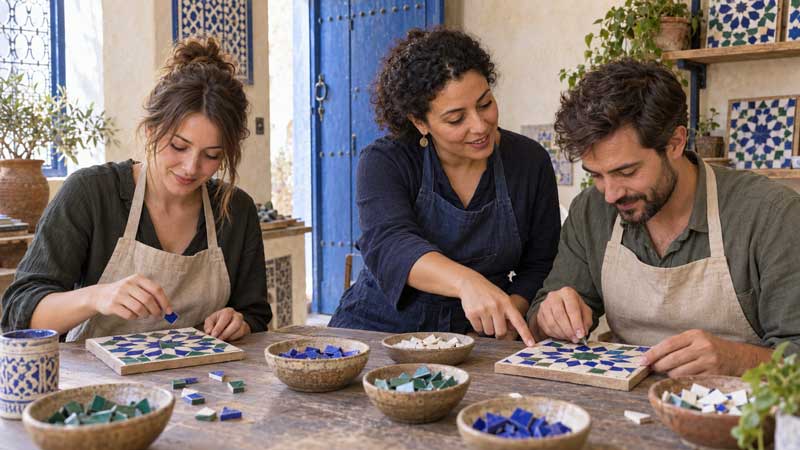
The experience page lists approximately two hours and no previous mosaic experience is required. Most projects can be taken home at the end of the session; larger or more complex pieces may need additional preparation. Confirm the project and collection arrangements when booking, particularly if you leave Fes soon afterwards.
Come with a question as well as a design in mind. You might ask your instructor which detail they check first, or how they decide that a piece belongs in a particular place. These small conversations can become the part of the visit you remember most clearly.
When you next stand in front of a Moroccan mosaic, choose one piece and follow the pattern outward. You will have a more personal sense of the attention behind it, and of the people whose work allows the whole surface to hold together.
COMMON QUESTIONS
Questions about Moroccan zellige and its makers
Is Moroccan zellige made by hand?
Traditional zellige involves substantial handwork, including shaping, glazing, cutting and assembly. Methods and equipment differ between producers. For a particular object, ask who made it and which stages were carried out by hand rather than judging authenticity from appearance alone.
Does one artisan make an entire mosaic?
Sometimes an artisan performs several stages; other projects involve a team. There is no universal headcount. Asking who prepared, cut and assembled a panel gives a more useful picture than assuming one person did everything.
How long does a zellige panel take to make
The answer depends on its size, the complexity of the design, the available pieces and the production schedule. A beginner’s small assembly project is not a measure of the time needed to produce and install an architectural mosaic. Ask the maker about the specific work.
Are zellige patterns painted onto the tiles?
In a traditional cut-tile mosaic, the larger pattern is built by fitting separate ceramic shapes together. That differs from painting a complete motif onto one tile. The small pieces, their colours and their arrangement create the composition.
Can a beginner try a zellige workshop in Fes
Yes. Our session uses pre-cut pieces and guided assembly, so you can start with no mosaic experience. Check the available projects and mention any individual needs when enquiring. The aim is to enjoy an introduction to the craft and understand some of its design decisions.
Why is mosaic zellige assembled face-down?
Placing the glazed faces against a flat surface helps align the visible side even when handmade pieces vary slightly in thickness. It also allows the backing to be applied from behind.
What is the difference between zellige and ordinary ceramic tile?
Authentic zellige is characterised by hand production, tonal glaze variation and, in mosaic work, individual cutting and assembly. Factory ceramic tile is engineered for greater dimensional and colour consistency.
Is Moroccan zellige waterproof?
The fired glaze resists water, but a tiled surface is not automatically a waterproof construction. Wet areas require suitable substrate preparation, membranes, adhesives, grout and detailing.
Can zellige be used on floors?
Certain zellige products can be used on floors, but suitability depends on thickness, finish, traffic, slip considerations, installation and maintenance. Confirm requirements with the producer and installer.
Can beginners make a zellige mosaic?
Yes. Introductory workshops often use pre-cut pieces and simplified patterns, allowing participants to learn the design and assembly principles safely under artisan guidance.
Continue exploring traditional crafts in Fes
Meet local artisans and experience Moroccan pottery and zellige through guided, hands-on workshops.
Experience authentic zellige craftsmanship in Fes
Learn from local artisans, understand the geometry and create a personal Moroccan mosaic to take home.