
How Fes Pottery Is Made: From Local Clay to Hand-Painted Bleu de Fès Ceramics
From Local Clay to Hand-Painted Bleu de Fès Ceramics
From clay to finished ceramic
Prepare the clay
Clean and balance moisture for a workable ceramic body.
Knead the clay
Distribute moisture and remove trapped air.
Shape the form
Use the wheel, hand-building or a mould.
Dry gradually
Let moisture escape evenly to reduce cracks.
First firing
Transform fragile dry clay into ceramic.
Prepare the surface
Clean and ready the piece for decoration.
Paint by hand
Build Bleu de Fès motifs with controlled brushwork.
Apply the glaze
Create the intended finish and surface.
Final firing
Fuse decoration and glaze in the kiln.
Inspect & finish
Check stability, finish the base and pack safely.
Explore this guide
How Fes pottery is made
A hand-painted bowl from Fes may look effortless when it reaches a riad table or a traveller’s suitcase. Its journey, however, begins long before the blue decoration appears. Clay must be prepared, shaped, dried and fired. The surface then needs careful treatment before an artisan paints the patterns, applies the appropriate finish and returns the piece to the kiln.
Every stage depends on the one before it. Air trapped in the clay can weaken a piece. Uneven walls can distort during drying. A rushed firing can damage hours of work. Even the final brushstrokes demand an understanding of balance and symmetry, especially when a design must follow the curve of a bowl, plate or tagine.
This guide explains how Fes pottery is made, from the first preparation of the clay to the finished Bleu de Fès ceramic. It also shows what makes this tradition distinctive, how visitors can experience it and what to check when buying handmade pottery in Morocco.
Fes pottery is generally produced through a sequence of clay preparation, shaping, gradual drying, an initial firing, surface decoration, glazing or finishing, and a final firing. Exact materials and methods differ between ateliers, so the most reliable explanation comes from observing the artisans who make each piece.
What is Fes pottery?
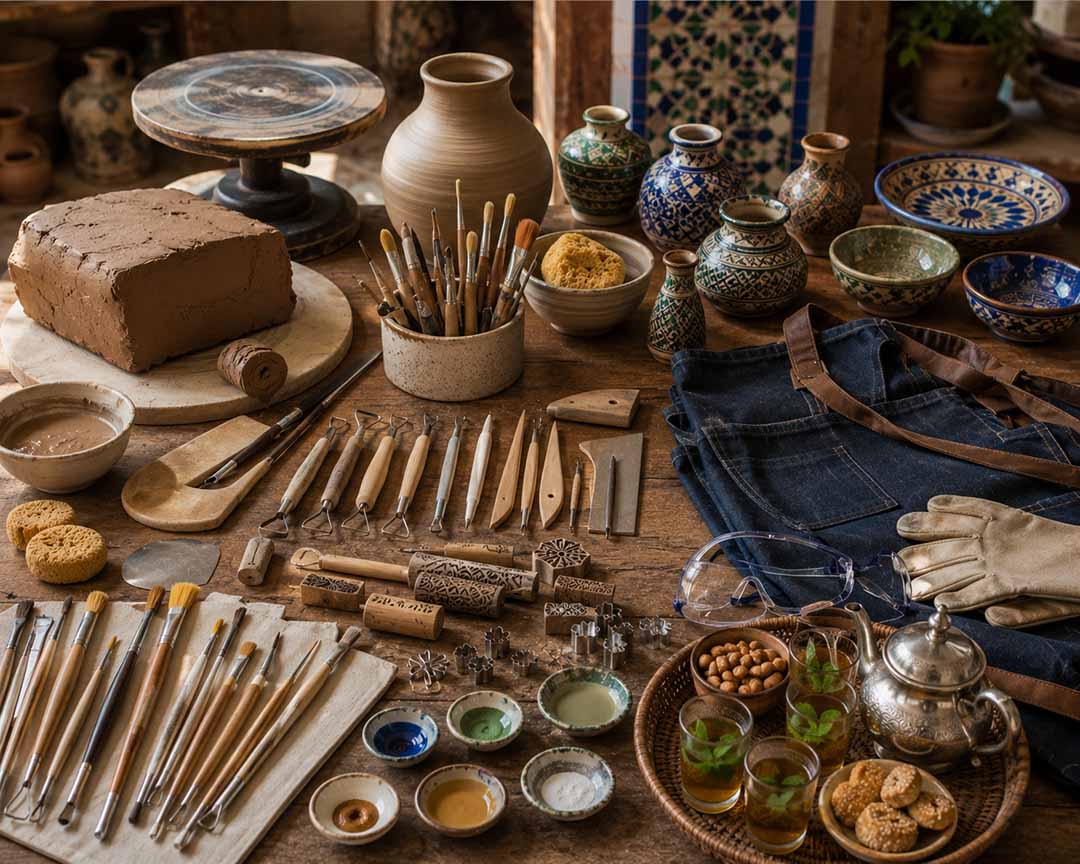
Fes pottery refers to ceramic work made in, or strongly associated with, the historic craft traditions of Fes. The city is particularly recognised for refined bowls, plates, jars, tagines and decorative pieces covered with carefully arranged patterns. Deep cobalt-blue decoration on a light ground is one of its most familiar visual signatures and is commonly described as Bleu de Fès.
The term does not mean that every ceramic object sold in Fes was made locally or produced entirely by hand. Modern shops can carry objects from several Moroccan regions and from different types of production. Authenticity therefore depends on transparent information about where a piece was made, which stages were performed by hand and what materials were used.
What makes Fes pottery distinctive?
Its identity comes from a combination of form, finish and decoration. Wheel-thrown objects require control of proportion and wall thickness. Painted pieces often use structured borders, central motifs, leaves, flowers and geometric repetition. The blue-and-white palette creates a recognisable Fassi character, although contemporary workshops may also use additional colours and modern designs.
| Pottery tradition | Common visual characteristics | Overall impression |
|---|---|---|
| Fes | Detailed blue decoration, a light background, and carefully organised floral and geometric patterns. | Refined and intricate |
| Safi | Broader colour combinations and a wide variety of decorative styles. | Colourful and expressive |
| Tamegroute | Green or ochre glazes with natural variations across the ceramic surface. | Earthy and distinctive |
| Rural pottery traditions | Natural clay tones, hand-built forms, and simpler decorative motifs. | Functional and organic |
These descriptions are broad orientation rather than strict rules. Moroccan pottery evolves, and individual artisans may combine inherited techniques with contemporary forms.
Why is Fes famous for pottery?
Fes has long brought craftspeople, merchants and customers together. Its historic medina developed around networks of specialised trades, and ceramic knowledge became part of a wider artisan environment that also includes zellige, leatherwork, metalwork, carved plaster and weaving. Pottery was never only an object for display: bowls, dishes, tagines, jars and tiles served practical, architectural and ceremonial purposes.
Skills have traditionally been developed through observation and repetition. An apprentice learns how clay should feel, how to centre it, how quickly a piece can dry and how a brush behaves on a prepared surface. These judgements are difficult to acquire from written instructions alone. They emerge through repeated work beside experienced potters and painters.
The tradition remains alive because artisans continue to produce objects for everyday use, interiors, hospitality and international customers. Workshops preserve recognisable techniques while adapting sizes, patterns and colours to changing tastes.
How Fes pottery is made: the complete process
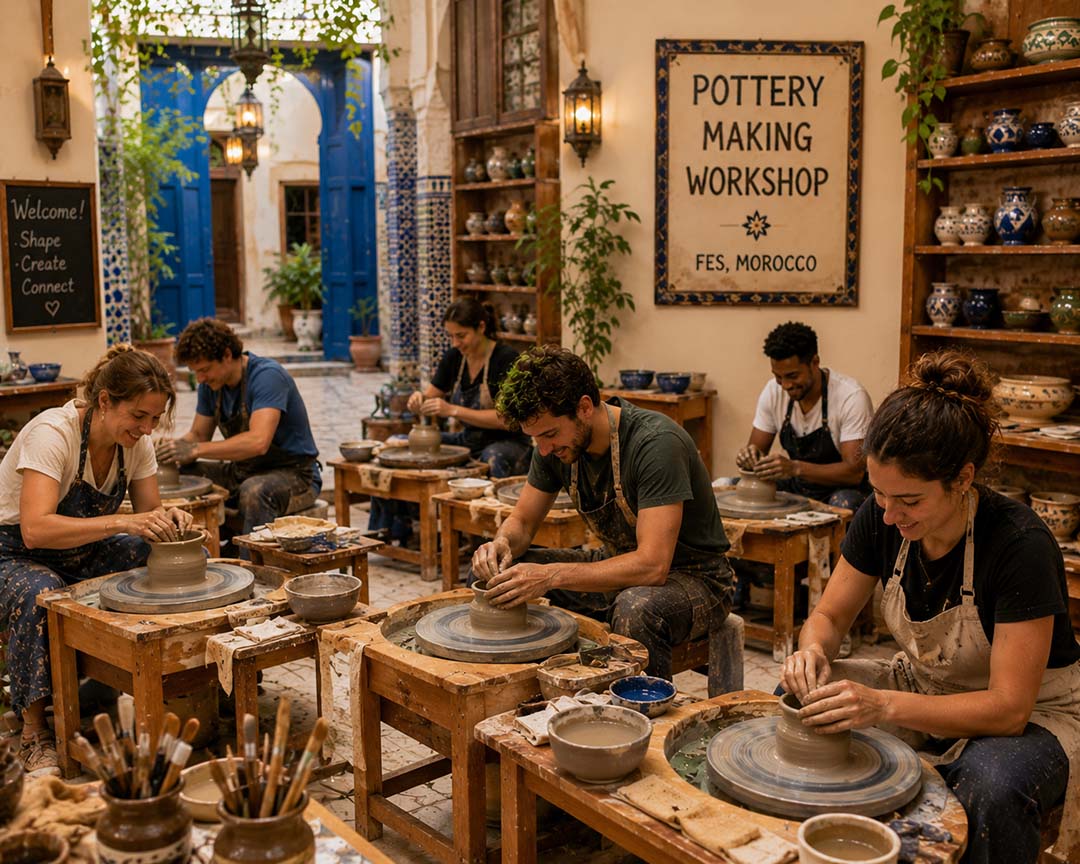
- Select and prepare the clay
- Knead the clay and remove trapped air
- Shape the object by wheel, hand or mould
- Dry the piece gradually
- Complete the first firing
- Prepare the ceramic surface
- Paint the decoration by hand
- Apply glaze or the required finish
- Complete the final firing and cooling
- Inspect, finish and pack the object
The production sequence can vary according to the atelier, the type of clay and the intended object. A hand-painted plate, a cooking vessel and an architectural tile do not necessarily follow an identical recipe. The following stages describe the general logic of traditional ceramic production in Fes.
Step 1 — Selecting and preparing the clay
The quality of a ceramic object begins with the clay. Raw material may contain stones, grit or inconsistent moisture, all of which can interfere with shaping and firing. The clay is therefore cleaned and prepared until it has a workable, reasonably uniform texture.
Moisture matters. Clay that is too dry can crack while being shaped; clay that is too wet may collapse or fail to hold a precise form. Preparation gives the potter a predictable material and reduces weaknesses that may only become visible after firing.
Is Fes pottery made from local clay?
Many descriptions associate Fes ceramics with clay obtained from the surrounding region, but sourcing can vary between ateliers and over time. A publication should not name a specific quarry or location unless the workshop confirms it. The strongest version of this section would include a short quotation from a participating potter explaining where the atelier obtains its clay and why it is suitable for the objects being produced.
Step 2 — Kneading the clay
Before clay reaches the wheel, it is kneaded or wedged. This distributes moisture more evenly and helps remove pockets of air. The action resembles kneading dough, but the goal is ceramic consistency rather than elasticity. A well-prepared block responds more evenly to pressure and is easier to centre.
This stage appears simple when performed by an experienced artisan. In practice, incomplete wedging can leave weaknesses inside the clay, while excessive handling can dry the surface or introduce new inconsistencies.
Step 3 — Shaping the pottery
Working on the potter’s wheel
For a wheel-thrown object, the potter places a prepared mass of clay at the centre of the wheel. Centring is essential: if the clay rotates unevenly, every later movement becomes more difficult. The artisan opens the centre, raises the walls and controls their thickness while the form turns continuously.
The rim, base and overall profile are refined before the object is carefully removed. A bowl that looks simple may require years of practice to reproduce consistently. The potter must coordinate speed, pressure and moisture while making constant small corrections.
Hand-building and mould-assisted forms
Not every ceramic piece is wheel-thrown. Artisans may build with coils or slabs, shape elements by hand or use moulds for forms that require repeated dimensions. Handles, feet and decorative additions may be made separately and attached at the correct stage.
Step 4 — Drying the shaped pottery
Freshly shaped clay contains too much moisture to enter a hot kiln immediately. It must dry gradually so that water leaves the piece as evenly as possible. If one area dries faster than another, tension can cause warping or cracks. Thick objects and attached handles require particular attention because different sections can shrink at different rates.
How long does pottery take to dry?
There is no universal drying time. It depends on the thickness and size of the object, the clay body, air circulation, humidity, temperature and the practices of the atelier. For that reason, visitors who shape fresh clay during a short workshop should not assume that the finished piece will be ready to take away on the same day.
Step 5 — The first firing
Once the object is fully dry, it undergoes an initial firing. Heat transforms the fragile dry clay into a stronger ceramic body. Controlled heating is important because residual moisture, rapid temperature change or weaknesses in the form can cause damage. Cooling also takes time; opening a hot kiln too early can expose ceramics to thermal shock.
Traditional and modern kilns
Kiln technology differs between workshops. Some ateliers preserve older kiln designs, while others use gas or electric equipment for more predictable temperature control. Avoid describing one kiln type as universal. Original photographs and a verified explanation from the workshop will make this section both more accurate and more valuable to readers.
Step 6 — Preparing the ceramic surface
After the first firing, the ceramic surface is cleaned and checked. Depending on the production method, it may receive a light-coloured coating or another form of preparation before decoration. The objective is to give the painter a consistent surface and help the final colours and finish develop as intended.
At this stage, the object is already firm, but it is not yet complete. Chips, cracks or major distortion may disqualify it before more time is invested in painting.
Step 7 — Hand-painting Bleu de Fès ceramics
Painting is the stage most travellers immediately associate with Fes pottery. An artisan may divide a plate into borders and central areas before adding floral, geometric or abstract motifs. On a curved object, the design must remain balanced even though the painter cannot see the entire surface from one angle.
What is Bleu de Fès?
Bleu de Fès is the name commonly used for the deep blue decoration associated with Fassi ceramics. The colour is traditionally linked to cobalt-based pigments, although the exact materials and formulas used today should be confirmed with the producer. On a light surface, blue lines create strong contrast and make detailed brushwork visible.
Why hand-painted pieces are never completely identical
A human hand creates subtle differences in line width, spacing and brush pressure. These variations can make each object individual. However, “handmade” should not be used to excuse structural cracks, unstable bases, sharp damaged edges or careless finishing. Character and poor quality are not the same thing.
Patterns should also be described carefully. Floral forms, leaves, repeated borders and geometric structures are common, but not every motif has one fixed symbolic meaning. Claims about symbolism should come from the artisan or a reliable cultural source rather than being invented for marketing.
Step 8 — Glazing the pottery
Ceramic glaze is a coating that changes during firing and forms the final visible surface. It can add shine, intensify colour, reduce porosity and make an object easier to clean. The precise glaze and its application depend on the intended use and the atelier’s process.
Does glaze automatically make pottery food-safe?
No. A glossy surface is not proof that an object is suitable for food. Food safety depends on the glaze composition, firing process, condition of the piece and applicable testing or production standards. Buyers should ask whether a ceramic item is decorative, suitable for serving food, intended for cooking, dishwasher-safe or microwave-safe. If the seller cannot answer clearly, treat the object as decorative.
Step 9 — The final firing
The decorated and glazed object returns to the kiln. During this firing, the surface develops its final appearance and the glaze fuses to the ceramic body. Temperature, atmosphere and timing influence the result. Colours that looked muted before firing may become stronger, while defects may only become visible after cooling.
For artisans, opening the cooled kiln is a moment of evaluation. Several days of work can be confirmed, or lost, at this stage. This uncertainty is one reason handmade ceramics cannot be judged only by the minutes spent painting the final design.
Step 10 — Inspection and finishing
Finished pottery is examined for shape, stability, cracks, glaze problems and decorative quality. The base may require smoothing so that it sits safely on a table. Dust is removed, pieces are sorted and fragile objects are wrapped for sale or transport.
| Natural handmade variation | Potential quality problem |
|---|---|
| Small differences in brushwork | Structural cracks or spreading hairline cracks |
| Minor variations in shape | An unstable or severely warped base |
| Slight colour differences | Sharp chips on rims, handles, or edges |
| Individual pattern details | A flaking surface or poorly attached handle |
Who makes Fes pottery?
A finished ceramic piece may involve several specialists. One artisan prepares or shapes the clay, another manages firing, and a painter adds the decoration. Larger ateliers may divide work more formally, while smaller workshops may combine responsibilities.
The role of the master potter
The potter understands the behaviour of clay through touch. Decisions about moisture, centring, wall thickness and drying are made quickly because the material changes during work. Consistency does not come from a machine; it comes from thousands of repeated movements and corrections.
The role of ceramic painters
Painters translate a visual system onto three-dimensional forms. They control line, spacing and symmetry while adapting the design to bowls, plates and vessels of different proportions. Their work is both decorative and technical.
How skills are passed on
Craft knowledge is often transmitted through demonstration, apprenticeship and family workshops. A learner begins with preparation and simple tasks, observes experienced artisans and gradually attempts more demanding stages. Publishing the names, experience and quotations of participating artisans, with their permission, will strengthen the article’s originality and expertise.
How long does it take to make Fes pottery?
The complete process can take several days or longer. Shaping may be relatively quick for a master, but drying cannot always be accelerated safely. Firing and cooling occupy additional time, and decoration adds another specialist stage. Production schedules also depend on when a kiln contains enough work to be fired efficiently.
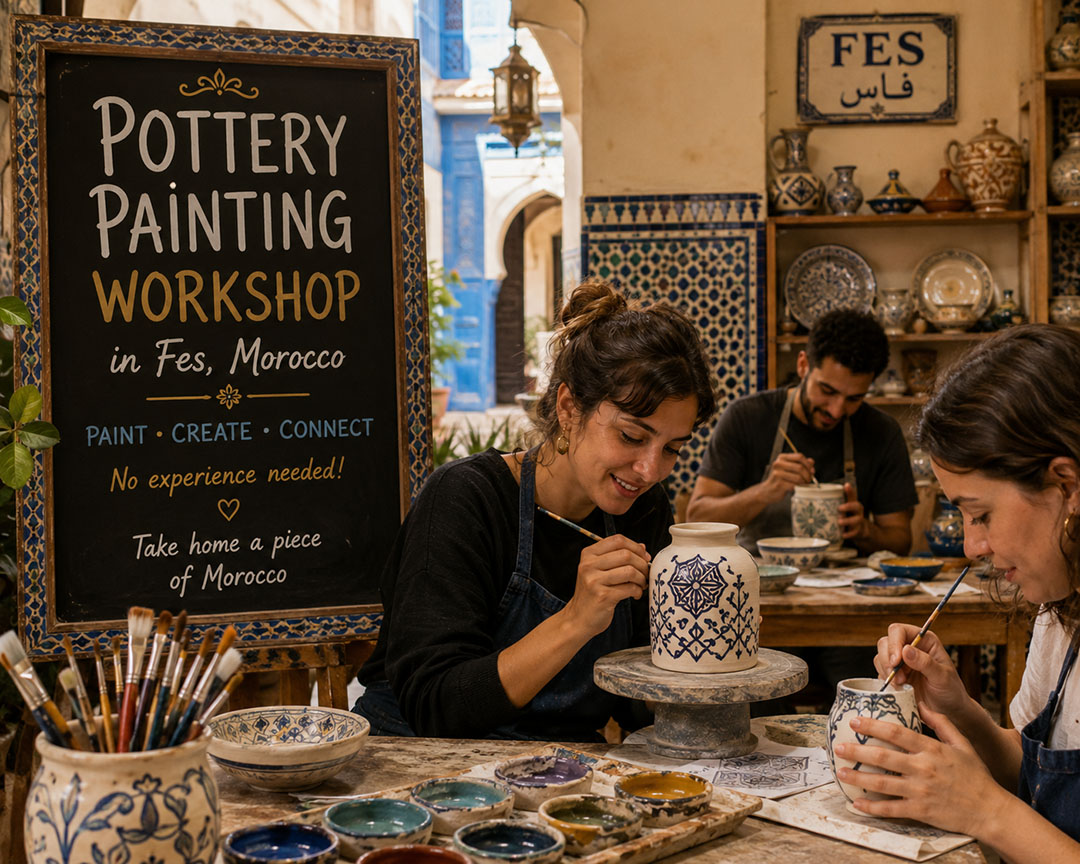
A two- or three-hour pottery workshop introduces selected techniques; it does not reproduce the entire production cycle. State clearly whether guests shape fresh clay, paint a prepared ceramic object, observe firing, collect their piece later or arrange shipping.
Can visitors make their own pottery in Fes?
Yes. Beginner-friendly workshops allow travellers to move beyond observation and understand the material through direct practice. Depending on the selected experience, a participant may tour an atelier, watch a wheel demonstration, try to centre clay, shape a simple object or paint Moroccan-inspired patterns on a prepared piece.
Do you need previous experience?
Most introductory visitor workshops are designed for beginners. The artisan demonstrates each movement and assists with difficult stages. Participants should approach the experience as an introduction to a skilled tradition rather than expecting professional results in one session.
Can you take your pottery home immediately?
It depends on the activity. Freshly shaped clay generally needs drying, firing and possibly glazing before it is ready. A pre-fired object used for painting follows a different timetable. Confirm collection, delivery or shipping arrangements before booking, especially if you are leaving Fes the following day.
Experience the complete craft with a local artisan. Shape clay, explore traditional techniques and discover the skill behind Fes ceramics.
How to recognise authentic handmade Fes pottery
- Look closely at brush lines and repeated motifs. Natural variation can reveal hand painting.
- Examine the shape, rim, handles and base for structural problems.
- Ask whether the ceramic is decorative, suitable for serving food or intended for cooking.
- Request care instructions rather than assuming it can enter a dishwasher or microwave.
- For a valuable purchase, ask who made it and whether the production can be observed.
Start by asking questions rather than relying on labels. A transparent atelier or seller should be able to explain where an object was made, how it was shaped, whether it was painted by hand and what it is intended to be used for.
Price alone does not prove authenticity, and a deliberately “imperfect” appearance does not automatically prove hand production. The most convincing evidence is a clear, observable process supported by knowledgeable artisans.
How to pack and transport Fes pottery
Fragile pottery should be wrapped individually, with additional protection around rims, handles and feet. Fill hollow spaces carefully and prevent objects from moving inside the luggage. Keep delicate pieces in hand luggage when airline and security rules permit.
For large purchases or international delivery, request written details covering packaging, carrier, cost, expected delivery time, customs responsibility and what happens if an item arrives damaged. Photographs taken before shipping can help document its condition.
Why traditional Fes pottery still matters
Fes pottery connects everyday objects with accumulated knowledge. A bowl carries decisions about material, proportion, heat, colour and pattern. When visitors understand those decisions, they are less likely to see handmade work as interchangeable decoration and more likely to appreciate the time behind it.
Responsible workshops can provide artisans with income from their knowledge as well as from finished objects. They also create a setting for respectful conversation. The strongest experiences present artisans as skilled professionals, explain what guests will genuinely do and avoid turning a working atelier into a staged backdrop.
Experience Fes pottery with local artisans
The blue decoration may be the first detail people notice, but it is only one stage in a much longer process. Clay preparation, shaping, drying, firing and surface finishing all contribute to the final piece. Trying even one of these stages makes the precision of the complete craft easier to understand.
Whether you choose wheel throwing, pottery painting or a guided pottery-and-zellige tour, look for an experience that gives you meaningful time with the material and a clear explanation of the artisan’s work.
Frequently asked questions about Fes pottery
How is Fes pottery made?
Fes pottery is generally made by preparing and kneading clay, shaping it by wheel, hand or mould, drying it gradually, completing an initial firing, preparing and painting the surface, applying glaze or another finish, and firing it again. Exact methods vary by atelier and object.
What is Bleu de Fès pottery?
Bleu de Fès describes the deep blue decoration strongly associated with ceramics from Fes. Artisans use blue lines and motifs—often floral or geometric—on a light surface to decorate bowls, plates, tagines and other objects.
Is Fes pottery made by hand?
Many traditional stages are manual, including shaping, trimming and painting. However, production methods differ, and not every object sold in Fes is locally handmade. Ask the producer to explain which stages were completed by hand.
What type of clay is used?
Clay composition and sourcing differ between workshops. Avoid assuming that every atelier uses clay from the same location. For an exact answer, ask the potter where the material comes from and how it is prepared.
How long does Fes pottery take to make?
The complete process can take several days or longer because shaped clay must dry, firing and cooling require time, and decoration may be completed by another specialist. Size, thickness, weather and workshop schedules all influence timing.
Is Fes pottery food-safe?
Not automatically. Food safety depends on materials, glaze, firing and the intended use of the object. Ask specifically whether the piece is decorative, suitable for serving food or designed for cooking.
Can beginners join a pottery workshop in Fes?
Yes. Introductory workshops are typically guided and designed for people without previous experience. Confirm the exact activities, duration and language before booking.
Can children participate?
Some pottery and painting activities can suit families, but minimum ages and supervision depend on the tools, materials and workshop. Confirm the requirements directly with the organiser.
Can I take my pottery home?
It depends on what you make. Fresh clay generally needs drying and firing, while a decorated prepared piece may follow a different schedule. Ask about collection or shipping before the workshop.
What is the difference between pottery and zellige?
Pottery creates vessels and objects by shaping clay. Zellige uses glazed clay tiles that are cut into geometric pieces and assembled into mosaics. Both begin with clay but require different specialist techniques.
Experience the craft—not just the souvenir
Meet local artisans, learn the techniques behind Fes ceramics and create a piece with your own hands.
Trackbacks/Pingbacks