
Pottery Factory Tour or Hands-On Workshop in Fes: What’s the Difference?
By Workshops in Fes
A pottery tour in Fes is a chance to watch skilled artisans and understand their work. A hands-on workshop gives you time to try a craft yourself. The right choice depends on whether you want an introduction to Moroccan ceramics, a creative session, or an experience that combines both.
The difficulty is that “workshop” can mean a working studio as well as a class. A listing for a pottery workshop visit might describe demonstrations and a showroom, while a pottery-making class should explain what you will actually do. Before you book, look beyond the name and check the participation, materials, and finished-piece arrangements.
This guide compares a pottery factory tour and a hands-on workshop in Fes, including painting and zellige options, so you can choose an experience that fits your interests and travel plans.

Pottery tour vs workshop in Fes at a glance
The clearest difference is your role. On a tour, you primarily observe, listen, and ask questions. During a class, you practise a particular activity with an instructor. Neither format is automatically better: each offers a different way to spend time with local craftsmanship.
|
What to compare |
Guided studio tour |
Hands-on workshop |
|---|---|---|
|
Your participation |
Watching and asking questions |
Making, painting or assembling |
|
Learning focus |
Overview of production and skills |
Techniques for a particular project |
|
A piece to keep |
Purchases may be separate |
Depends on the booked activity |
|
Timing |
Check the tour itinerary |
Check making and finishing time |
|
Best fit |
Understanding the craft |
Trying the craft yourself |
Some experiences combine a guided visit with a practical session. Confirm how much time is allocated to each rather than assuming that every visitor gets time at a pottery wheel.
What happens during a pottery factory tour in Fes
Observe the craft from clay to decoration
A guided pottery studio visit introduces you to the people, tools, and stages behind finished ceramics. Depending on the atelier and its work that day, you may see clay being shaped, a potter working at the wheel, decorative painting, or zellige pieces being prepared and arranged. Your host explains how the stages connect.
You will usually see different objects at different stages. A short visit cannot follow one freshly shaped pot through drying, firing, and finishing. Kilns also operate on a production schedule, so an explanation of firing does not necessarily mean you will watch a kiln being opened during your visit.
If you would like more background before arriving, read our guide to how Fes pottery is made. Understanding the sequence makes it easier to appreciate the work happening around you.
Ask questions and explore finished pieces
Observation gives you room to notice details: how a potter controls the rim, how a painter repeats a pattern, or how small mosaic pieces fit together. Ask which steps are performed at the studio and what skills take longest to learn. Check before photographing an artisan or entering a working area.
Some tours finish with time in a showroom. That can be useful if you want to see completed work, but purchases are separate from participation unless the booking says otherwise. Ask about any entry charge, optional shopping, and what the visit includes before you arrive.
Our pottery and zellige guided tour in Fes focuses on observation and learning. Hands-on participation is a separate experience, so choose a practical session if making your own piece is your priority.
What happens during a hands-on workshop
A hands-on workshop makes you part of the activity. The instructor demonstrates a technique, helps you try it, and guides you through a manageable project. The important question is which craft you will practise: pottery-making, ceramic painting, and zellige assembly are different experiences.
Pottery making means working with clay
In a pottery-making session, the starting point is clay. Depending on the class, you may shape by hand or try working at the wheel. Your instructor can help you understand pressure, balance, and how small movements change the form. A first attempt may be uneven, and that is part of learning.
Ask whether every participant gets individual wheel time, whether wheels are shared, and how long you spend shaping. A demonstration followed by a brief turn is different from a session built around sustained practice. Choose the format that matches how deeply you want to explore the technique.
Explore our pottery-making workshop in Fes if working directly with clay is what interests you.
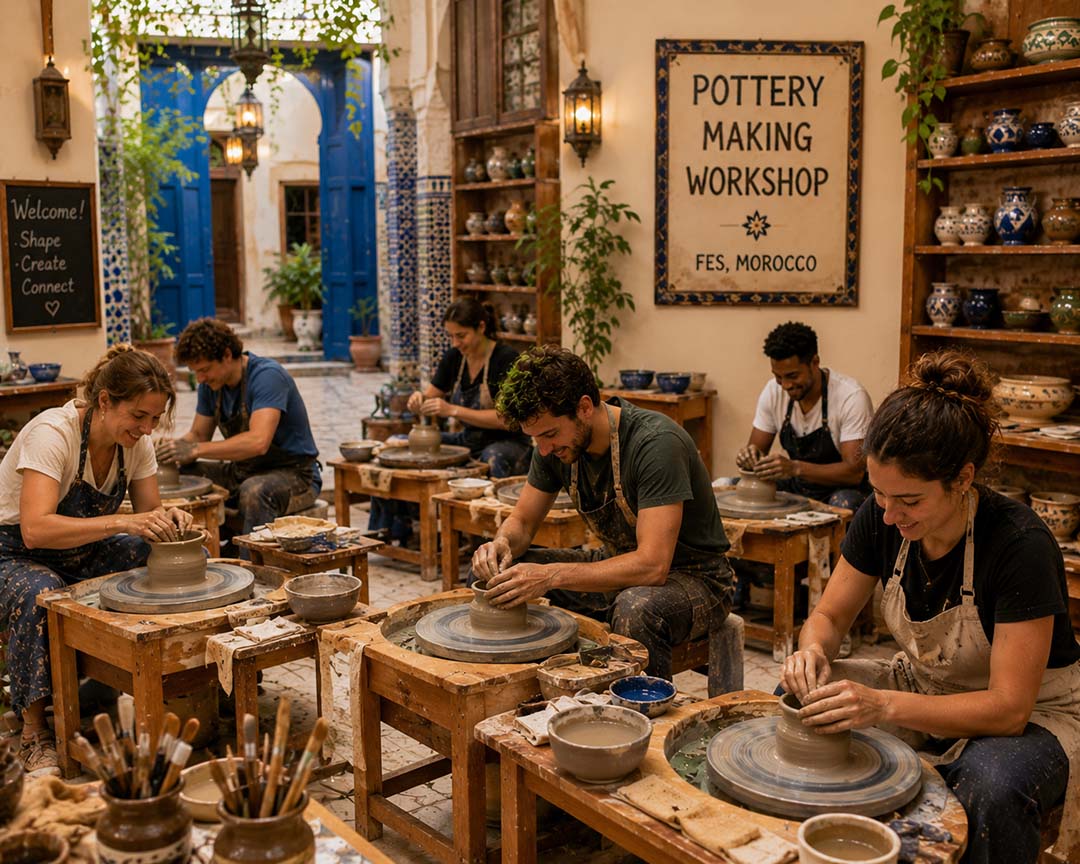
Pottery painting focuses on colour and decoration
A pottery-painting experience generally starts with a prepared ceramic piece. You focus on the surface: choosing colours, planning a motif, and applying the decoration. It is a good option if the patterns on Moroccan ceramics interest you more than shaping the vessel itself.
Painting does not automatically include time at a pottery wheel. Finishing also varies with the piece and materials, so ask whether the decoration requires another firing and when the piece can be collected. Our pottery-painting workshop is the relevant option to explore for a decoration-focused session.
Zellige introduces mosaic composition
A zellige workshop centres on ceramic pieces and the way they form a pattern. Depending on the session, participants may arrange prepared shapes and assemble a small mosaic under guidance. This can suit visitors who enjoy geometry, colour combinations, and working carefully through a design.
Watching an artisan cut tiles is different from cutting them yourself. Do not assume a beginner session includes every stage of production. Ask which steps you will perform and which the artisan will demonstrate or complete. See our zellige mosaic workshop in Fes for this type of experience.

What a beginner can realistically achieve
A first workshop is an introduction to a skill, not a shortcut to professional craftsmanship. The useful outcome is time spent trying a technique, understanding the materials, and completing or developing a suitable project. Ask to see examples made by previous beginners rather than judging your expected result against an artisan’s display pieces.
Can you take your creation home the same day
A piece being included in the workshop does not always mean it is ready to travel immediately. Freshly shaped clay needs further processing before it becomes a finished ceramic object. Painted pieces may require additional finishing or firing, depending on the materials used. Mosaic readiness depends on the assembly and setting method.
Tell the provider when you leave Fes before selecting an activity. Ask for a clear collection arrangement rather than relying on “take home your creation” alone. You need to know when the piece will be ready, where to collect it, and what happens if your itinerary changes.
If delivery or shipping is offered, confirm the destination, cost, packaging, and expected dispatch arrangements separately. These should not be assumed to be included in the class price. Travellers leaving the next morning should choose an activity whose finishing schedule genuinely fits that departure.
How to compare prices and inclusions
Compare what you receive, not just the headline price. A guided visit, a brief wheel demonstration, and a practical class with individual attention are different products. Group size, materials, the number of pieces, and finishing arrangements can all affect the total cost.
Check whether the rate is per person or for a private group. Then look for materials, instruction, firing where relevant, packaging, and transport. A transfer from your riad may be included, optional, or unavailable. Collection or international delivery may also be a separate service.
A useful way to compare two offers is to ask each provider the same question: “What will I personally do, for how long, and what is included in the total?” A clear answer is more helpful than a long list of craft names. Confirm current prices directly on the experience page or when making your enquiry.
Which pottery experience should you choose
Choose a tour for observation and context
A tour suits a traveller who wants to understand how ceramics and mosaics are produced without committing to a making session. It also works well when different people in a group share an interest in culture but do not all want to practise a craft. Confirm walking, stairs, and seating if those affect your choice.
Choose a workshop for creative participation
Choose pottery-making if you want to handle clay, painting if you enjoy decoration, or zellige if you are drawn to patterns and assembly. For example, someone excited by the movement of a pottery wheel may find a painting-only session misses their main interest, even if the finished piece is beautiful.
Consider children and different interests
For families, suitability depends on the activity, the child’s age, the tools, and the supervision available. Ask what younger visitors actually do and whether accompanying adults need to book a place. Seated activities can still demand concentration and careful hand movements; short breaks may matter more than the total session length.
Our guide to things to do in Fes with kids can help you build a balanced day around a creative activity. Leave enough time to reach the venue and avoid squeezing the workshop between two fixed appointments.
Combine a visit and a class when the schedule allows
A combined experience can give you context before you try the craft. Confirm that both parts are included and ask how the time is divided. If your goal is a hands-on session, make sure the making time is not simply a brief addition to a much longer tour.
Seven questions to ask before booking
- Will I observe, participate, or do both?
- Which activity will I personally try, and how much practice time is included?
- What materials and finished pieces are included in the price?
- When will my creation be ready to collect?
- Where do we meet, and is transport included?
- What age, language, or accessibility arrangements should I confirm?
- Are purchases optional, and are there any additional finishing or delivery costs?
Keep the answers with your booking confirmation. They make it easier to choose confidently and give the host a chance to prepare for your group’s needs.
Find your pottery experience in Fes
Start with the part of the craft you most want to experience. Observe the process on a guided visit, shape clay in a pottery-making session, decorate a ceramic piece, or assemble a zellige design. Then confirm the practical details that matter for your trip, especially participation time and collection.
Browse our pottery and zellige experiences or contact Workshops in Fes. Tell us your preferred activity, group size, and departure date, and we can help you choose a suitable experience.