
Before It Reached Your Living Room: The Life of a Moroccan Carpet
You move a chair, roll back a corner, and suddenly the room feels different. A carpet has a quiet way of organising a home. Its colour draws your eye; its texture changes how the floor feels. But the finished surface tells you very little about what happened before it arrived.
To understand how Moroccan carpets are made, follow the material backwards from that room: through finishing and the loom, to the yarn and the fleece. Then follow it forward again. Each stage explains something you can see or feel in the finished rug.
This journey focuses on handmade wool carpets, while recognising that Morocco has many textile traditions. Some rugs are flatwoven; others have a knotted pile. Materials and methods vary. Knowing those differences makes a visit to a weaving atelier in Fes far more interesting.
How Moroccan carpets are made
For a wool carpet, the broad journey runs from fleece selection and cleaning to fibre preparation, spinning, colour preparation, loom setup, weaving or knotting, and finishing. Dyeing can happen at different stages. A particular rug may involve several specialists, and the weaver may begin with yarn that has already been prepared.
A carpet takes its shape from a home
A useful place to begin is a nineteenth-century Rabat carpet in the Metropolitan Museum of Art collection. The museum connects its elongated shape with the long, narrow living spaces of local architecture. Here, the shape of the room helps explain the shape of the textile.
That is a more revealing starting point than asking whether a carpet is simply “traditional”. Someone had to consider where it would lie, how much floor it would cover, and how its design would read across that space. The finished object belongs to a practical setting as well as a visual tradition.
There is no single Moroccan carpet style. The Dar Si Saïd National Museum of Weaving and Carpets brings together urban and rural carpets, high-pile textiles, hanbel and other woven forms from different regions. A plush rug and a lighter flatweave can both belong to Moroccan textile culture without sharing the same construction.
Before there is yarn there is wool
Selecting and cleaning the fleece
For a sheep-wool carpet, preparation starts with the fleece collected through shearing. The material has to be sorted and cleaned before it can become usable yarn. Washing removes grease and dirt; the technical term for this cleaning stage is scouring.
The transformation is easy to underestimate when you first encounter tidy balls of wool in a workshop. Those balls are already the result of preparation. Ask whether the yarn was made locally, bought ready-spun, or prepared by the maker’s own team. The answer helps you understand how this particular carpet began.
Carding and spinning
Carding opens and separates tangled fibres in preparation for spinning. Spinning draws the fibres into a strand and adds twist so they hold together as yarn. Woolmark’s guide to wool processing explains these stages, although a craft workshop’s tools and scale can differ from industrial production.
Look closely at a loose strand before looking at the pattern. Is it fine or thick? Smooth or softly irregular? These details are part of the material the weaver works with. A handmade carpet may use hand-spun or machine-spun yarn; “handwoven” describes the weaving and does not, by itself, tell you how the yarn was produced.
Colour is a choice with its own history
Some designs use the natural shades of wool. Others use dyed fibre or yarn. Natural and synthetic dyes both appear in contemporary Moroccan textile production: Anou’s account of its wool supply initiative describes the use of both.
A muted shade does not prove a natural dye was used, and a vivid colour does not establish the opposite. If colour matters to your choice, ask the maker what was used. Keep that answer with the rug’s care instructions; it is more useful than guessing from a photograph.
The loom turns yarn into a surface
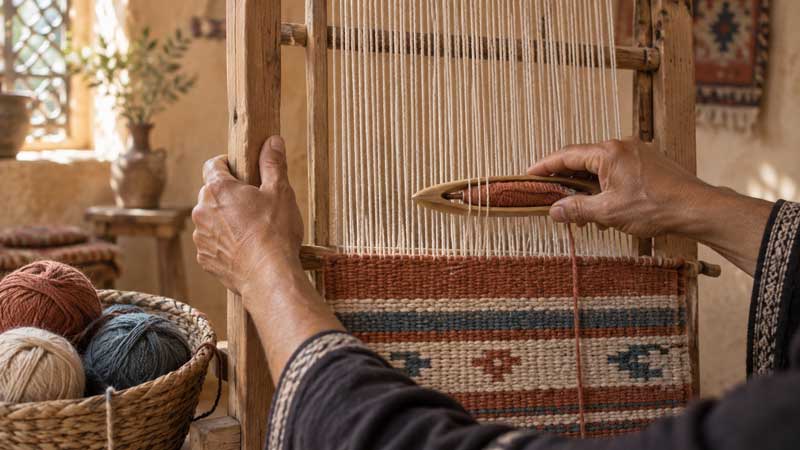
At the loom, the future carpet is still partly empty space. Threads held under tension establish a framework, and each new passage of yarn fills a little more of it. This is where the scale of the work becomes visible: a large carpet has to be built across its width and along its length.
Understanding warp and weft
The warp is the set of lengthwise threads held under tension on the loom. The weft travels across them. In a basic weave, the weft interlaces with the warp; successive rows build the textile. On an upright loom, the warp usually appears vertical and the working area develops across it.
The setup affects the work that follows. The weaver needs suitable spacing and controlled tension, as well as a plan for the width and edges. A beginner quickly discovers that pulling a row too tightly can draw the sides inward.
Flatwoven carpets and knotted pile rugs
A flatwoven rug has no raised knotted pile. Its surface comes from the interlaced yarns. A hand-knotted pile rug adds yarn tied around the warp; the projecting ends form the pile, with weft rows helping hold the structure together. Both involve a loom, but the actions and resulting surfaces differ.
Contemporary maker Beni Rugs explains this distinction in its guide to rug construction. The useful question is not which technique is more “authentic”, but which structure you are looking at. Feel the surface, examine the reverse with permission, and ask the maker to explain how it was built.
The pattern develops one decision at a time
From across a room, you see a diamond, a border or a field of colour. At the loom, that same design becomes a series of smaller decisions: where a colour begins, how far a line travels, and when the next shape starts. Even a spare design depends on keeping track of those relationships.
A pattern may be planned in advance, adapted during the work, or made to a customer’s brief. Ask which approach was used for the carpet in front of you. It makes room for the maker’s actual choices, including contemporary ones.
Motifs can have cultural associations, but a shape alone is not a reliable translation. If a seller describes a personal or regional meaning, ask where that interpretation comes from. A named maker’s explanation of their own design is more valuable than treating every diamond or zigzag as a word in a universal dictionary.
The last row is not the last step
When weaving ends, the textile still needs finishing appropriate to its construction. Ends must be secured, edges checked and loose threads dealt with. A pile rug may be trimmed to achieve the intended surface. Washing and thorough drying can also form part of the production process.
These steps vary between workshops. Beni Rugs, for example, describes washing its completed rugs before drying them on racks. That is a documented maker’s workflow, rather than a rule that every Moroccan textile receives an identical treatment.
Before a carpet leaves the workshop, its dimensions, finish and condition deserve attention. If you are buying a piece, ask for the finished measurements and care guidance. Factory or atelier washing is not an instruction to repeat the same treatment at home without knowing the fibres, dyes and construction.
How long does a handmade Moroccan carpet take
There is no reliable single answer. Size, construction, design complexity, the number of people working and the hours devoted to the piece all matter. Yarn preparation, finishing and drying may add time beyond the days spent at the loom.
For a commission, ask for the timeline for that specific rug and clarify what it includes. A delivery estimate is not the same as a count of weaving hours. For a visitor workshop, a small sampler is a realistic way to explore the process; completing a room-sized carpet is a different undertaking.
What travels home with the carpet
A rug carries useful information as well as a pattern. Before taking one home, ask who made it, where it was woven, what the pile and foundation are made from, and whether it is new or previously used. Request written details when they are available.
The town where a carpet is sold is not necessarily where it was woven. A shop in Fes may carry textiles from different parts of Morocco. Being specific about origin helps you appreciate the individual piece and avoids turning a place name into a claim the seller cannot support.
Once you know its construction, the carpet looks different. You can recognise the yarn beneath the colour, the repeated work beneath the pattern, and the decisions behind its proportions. It becomes easier to explain why this particular textile belongs in your home.
Try carpet weaving in Fes
You do not need to buy a carpet to become curious about how one is made. Sitting at a loom gives you a small, practical part of the answer. The challenge may be keeping the edges even, remembering the next pass, or choosing where a new colour should begin.
Our carpet weaving workshop in Fes introduces beginners to the loom and basic techniques with artisan guidance. Wool, weaving materials and equipment are included, and participants make a small woven piece to take home. The session offers an introduction to the craft; the project is sized for a visitor experience.
Before booking, ask which project and technique will be taught during your session. Confirm the duration, language and suitability for anyone travelling with children. If you prefer watching the process and asking questions, explore our carpet weaving tour in Fes instead.
Bring home your first woven piece
Choose a few colours. Learn how a row holds together. Make a small textile that reminds you of the time you spent at the loom in Fes.
Explore the carpet weaving workshop or contact Workshops in Fes with your preferred date, group size and language. We can help you choose the experience that fits your visit.
COMMON QUESTIONS
Questions about Moroccan carpet weaving
Are Moroccan carpets woven or knotted?
Both forms exist. Flatwoven carpets are made by interlacing yarns without a raised knotted pile. Hand-knotted rugs add knots to a woven foundation to create pile. Ask about the construction of the particular carpet rather than relying only on its style name.
Are all Moroccan rugs made from wool?
No. Wool is important in many traditions, but other materials and combinations are used. A wool surface does not necessarily mean the foundation is also wool. Ask separately about the pile, warp and weft when the fibre content matters to you.
Are natural dyes used in every handmade rug?
No. A handmade rug may use natural dyes, synthetic dyes, undyed yarn or a combination. The fact that a piece was woven by hand does not establish how its colour was produced.
Can a beginner make a complete carpet in one workshop?
A beginner can work on a small woven project chosen for the session. A full-size floor carpet involves substantially more work. Confirm the expected size and type of finished piece before booking.
What is the difference between a carpet and a tapestry?
Carpet usually describes a textile intended for the floor. Tapestry can describe a weaving technique as well as a decorative wall textile in everyday language. Workshop names sometimes use these terms broadly, so ask whether you will make a floor-use piece, wall hanging or sample.
Continue exploring traditional crafts in Fes
Meet local artisans and experience Moroccan pottery and zellige through guided, hands-on workshops.
Your Moroccan Story Starts at the Loom
Choose your colours, learn from a local artisan, and weave a small piece to take home. Discover carpet weaving in Fes through an experience you can touch, create, and remember.
No experience needed. Materials and artisan guidance included.