
The Pattern Above the Door: Discovering Moroccan Gebs
The next time you enter a courtyard in Fes, pause before walking through the door. Look above it. Follow the pale curves around the opening, the narrow leaves and repeating shapes, the small shadows caught inside the decoration. A surface that seemed almost flat from a distance begins to reveal its depth.
You may be looking at Moroccan gebs: decorative plasterwork, especially the hand-carved relief that gives so many architectural surfaces their fine detail. Recognising the material changes the question. Instead of simply admiring the pattern, you begin to wonder how someone planned it, where the tool first entered the plaster, and how much material they chose to leave behind.
This is a story about learning to notice that work. A historic madrasa in Fes gives us a documented place to start. A small plaster-carving panel offers a way to explore the same relationship between line, depth and light with your own hands.
What is Moroccan gebs
In Moroccan craft contexts, gebs refers to plaster and is commonly used for decorative plaster carving. Artisans develop geometric, plant-inspired or calligraphic designs in relief, removing material so that the remaining forms stand above a recessed background. English descriptions may also use the term carved stucco.
That vocabulary can be confusing when you first explore a building. A pale decorative band may look like carved stone; a delicate floral surface may resemble lace. Identifying it properly means looking at the material and consulting the building’s interpretation, rather than deciding from colour alone.
The Hassan II Mosque Foundation’s plaster museum information identifies geometric and vegetal decoration as important features of Moroccan carved plaster. These two approaches offer an accessible starting point: some designs invite you to follow a repeated structure, while others lead your eye along branching stems and curved leaves.
A doorway into the history of Fes
At the Attarine Madrasa in the old medina, plaster belongs to a larger architectural composition. The Museum With No Frontiers record places the monument in the fourteenth-century Marinid period and describes its carved plaster arches, inscriptions and floral decoration alongside tile mosaic and sculpted wood.
The building was a place of study and accommodation. Its decorated courtyard therefore belonged to an inhabited setting, with rooms and circulation beyond the surfaces we admire. Remembering that use gives the ornament a human scale: these were surroundings people moved through, rather than a collection of isolated decorative samples.
Try looking at such a space in two stages. First take in the complete wall, including the opening it frames. Then choose a small area of relief. Notice how much changes when the view moves from architecture to the edge of a single leaf.
A museum record can establish the history of a building without answering every question about every visible surface. Restoration also forms part of a monument’s life. If you want to know whether a specific section is original or renewed, ask a knowledgeable guide or consult the site’s interpretation.
Why the pattern belongs above the door
A doorway is a useful place to understand the relationship between decoration and architecture. Its edges give the design a boundary. A band can follow the opening; a larger field can fill the space above it. The eye reads the shape of the entrance and the detail around it together.
Rather than assigning one universal meaning to every decorated threshold, look at what the design does in that particular place. Does it draw your gaze upward? Does a dense pattern meet a quiet border? Does the surrounding wood make the pale relief more distinct? These are things you can investigate without needing to decode a hidden message.
From a drawn line to a carved surface
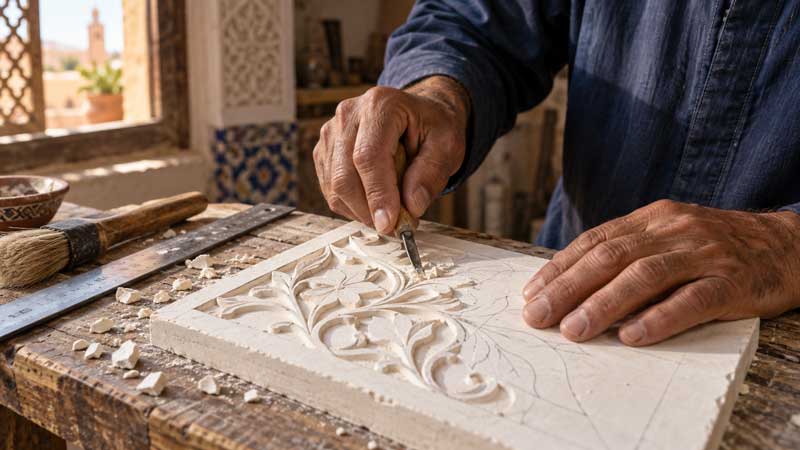
A finished plaster panel makes it easy to overlook the decisions that came before the carving. The person making it must consider the dimensions, the motif and how the design meets its edges. A repeating form needs enough room to repeat coherently; a curved leaf needs enough surrounding space for its outline to remain clear.
The Académie des Arts Traditionnels plaster programme shows the breadth of the discipline. Its training covers work from mixing plaster with water through to colouring a finished panel, alongside materials, production methods and architectural drawing. Professional skill extends beyond handling a tool.
Planning the motif
On a small practice panel, a drawn guide helps turn an idea into something workable. It gives you a chance to see the proportions before removing material. A simple design can be especially revealing: with fewer lines, it becomes easier to notice whether a curve is balanced or a border is too narrow.
Finding the depth
Carving asks you to think about what stays as well as what goes. A recessed area makes the neighbouring form more visible. A small adjustment to an edge can change the shadow it casts. The work becomes a sequence of decisions that affect both the surface and the way light reaches it.
During a demonstration, watch where the maker pauses. Ask which part of the design they are checking and how they choose the next area to work. For a first lesson, follow the instructor’s handling guidance and work on the prepared practice material. Architectural plasterwork involves conditions and skills beyond a short visitor session.
How to look closely at Moroccan plaster carving
Follow one repeated shape
Choose a leaf, a small star or a curved line and find the next occurrence. Does it reverse direction, rotate or connect with another element? Following one repeat makes a crowded surface easier to understand. You begin to see how the maker has organised the design rather than trying to take in every detail at once.
Notice the spaces between the forms
The background contributes to the pattern. Look at the recessed space around a leaf and the gap between two raised bands. These areas help define the forms you first noticed. In a carving workshop, this becomes practical: clearing a small area can make the surrounding motif read more clearly.
Let the light reveal the relief
From one position, pale plaster may appear almost uniform. Step to the side and a shallow cut can become visible through its shadow. On your own practice panel, changing its angle beneath a light is a useful way to examine depth without touching the carved details.
When photographing architectural plasterwork, include one wider view and one detail. The wider image records the setting; the detail records what caught your attention. Respect local photography rules and keep your hands away from historic surfaces.
Read inscriptions with context
Calligraphy can be part of carved architectural decoration, as the Attarine record demonstrates. If an inscription interests you, seek a reliable reading of that particular text. Its meaning should come from identification and translation, rather than a guess based on its decorative appearance.
Gebs and zellige in the same courtyard
The distinction between the two crafts becomes clearer when you look at how a pattern is formed. In carved gebs, material is removed from a plaster surface to create relief. In a traditional zellige mosaic, separate ceramic pieces are fitted together into a composition.
Both ask you to notice relationships between forms, but they involve different materials and actions. A visitor who enjoys carving and watching shadows develop may be drawn to gebs. Someone more interested in arranging coloured pieces may prefer a mosaic session. Our guide to how Moroccan zellige is made explains that craft in more detail.
A living skill with more than one route into it
Artisans can enter plaster carving through different routes. The Academy’s dedicated training programme is one documented example of knowledge being taught through organised study. Individual artisans may have learned through different combinations of training and workshop experience.
When you meet a maker, ask how they began. What did they practise first? What took the longest to learn? A specific answer from the person in front of you is more memorable than a general claim that every artisan follows the same path.
Try a plaster carving workshop in Fes
A beginner session makes the connection between architecture and handwork tangible. The decorative wall is large and complex; your panel is small enough to study closely. You can concentrate on a few lines and see how each decision affects the developing relief.
In our plaster carving workshop in Fes, you work with a prepared plaster panel, learn basic tool handling from an artisan and develop a decorative motif. The experience is designed for beginners, with guidance as you practise. You do not need previous carving experience to start.
Choose a manageable design and give yourself time to understand it. A clean curve or a clearly defined leaf can be a satisfying first result. The value of the session lies in discovering how the material responds and being able to ask questions while you work.
Before booking, confirm the duration, meeting point, language and arrangements for taking your panel home. If you are travelling with children, mention their ages so the host can advise on a suitable session. Ask how to support and pack the finished piece for your onward journey.
Bring the pattern into your own hands
The next doorway you notice in Fes may look different after a carving session. Your eye will have something concrete to follow: a line becoming an edge, a recessed area giving a leaf its shape, a small shadow revealing the depth of the work.
Join Workshops in Fes for an introduction to Moroccan gebs and create your own decorative plaster panel with artisan guidance.
Explore the plaster carving workshop or contact us to arrange your visit. Tell us your preferred date, group size and language.
COMMON QUESTIONS
Questions about Moroccan gebs
What does gebs mean in Moroccan crafts?
Gebs refers to plaster; in a craft or architecture context, it commonly describes ornamental plasterwork and carving. You may also see it written as gebs art or Moroccan plaster carving. The surrounding context tells you whether someone means the material or the decorative practice.
Is gebs the same as zellige?
No. Gebs carving creates relief in plaster. Traditional zellige mosaic combines shaped ceramic pieces. You can encounter both in the same architectural setting, but a plaster-carving session and a mosaic workshop involve different materials and techniques.
Is gebs the same as zellige?
No. Gebs carving creates relief in plaster. Traditional zellige mosaic combines shaped ceramic pieces. You can encounter both in the same architectural setting, but a plaster-carving session and a mosaic workshop involve different materials and techniques.
Where can I see carved plaster in Fes?
The Attarine Madrasa is a documented example, with carved plaster integrated into its architectural decoration. When planning a visit to a historic building, check current access arrangements locally. In other courtyards, ask a guide to help identify materials and distinguish older work from later restoration.
Is Moroccan plaster carving suitable for beginners?
An introductory workshop can be suitable for beginners when the project and tools are selected for that level. At Workshops in Fes, the activity uses a prepared panel and artisan guidance. Professional architectural work requires much more training and experience.
Can I take my plaster panel home?
The workshop is intended to include a panel you create and keep. Confirm when it will be ready to travel and how it should be packed. Ask the host about any preparation or handling needed before placing it in your luggage.
Does every pattern have a symbolic meaning?
Do not assume that every leaf, star or colour has a fixed meaning. Some designs are best understood through their geometry and composition; inscriptions need a reliable reading. Ask about the particular work you are viewing and separate documented meaning from personal interpretation.
Can zellige be used on floors?
Certain zellige products can be used on floors, but suitability depends on thickness, finish, traffic, slip considerations, installation and maintenance. Confirm requirements with the producer and installer.
Continue exploring traditional crafts in Fes
Meet local artisans and experience Moroccan pottery and zellige through guided, hands-on workshops.
Join an authentic workshop on plaster (Gebs) in Fes
Learn from local artisans, understand the geometry, and create a personal Moroccan Gebs to take home.