
Traditional Crafts of Fes: Pottery, Zellige, Leather, Weaving & Brass
Step inside the ateliers of Morocco’s artisan capital and discover how generations of makers transform clay, leather, wool and metal by hand.
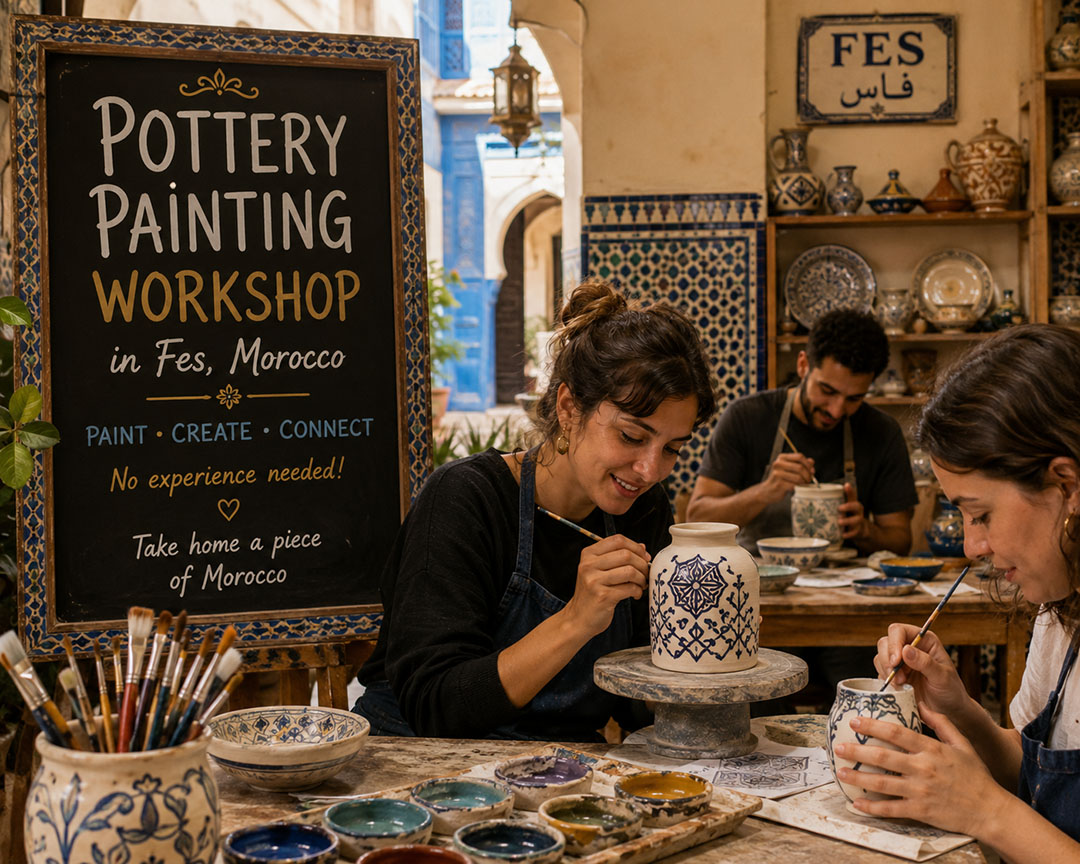
Pottery
Shape and decorate local clay.
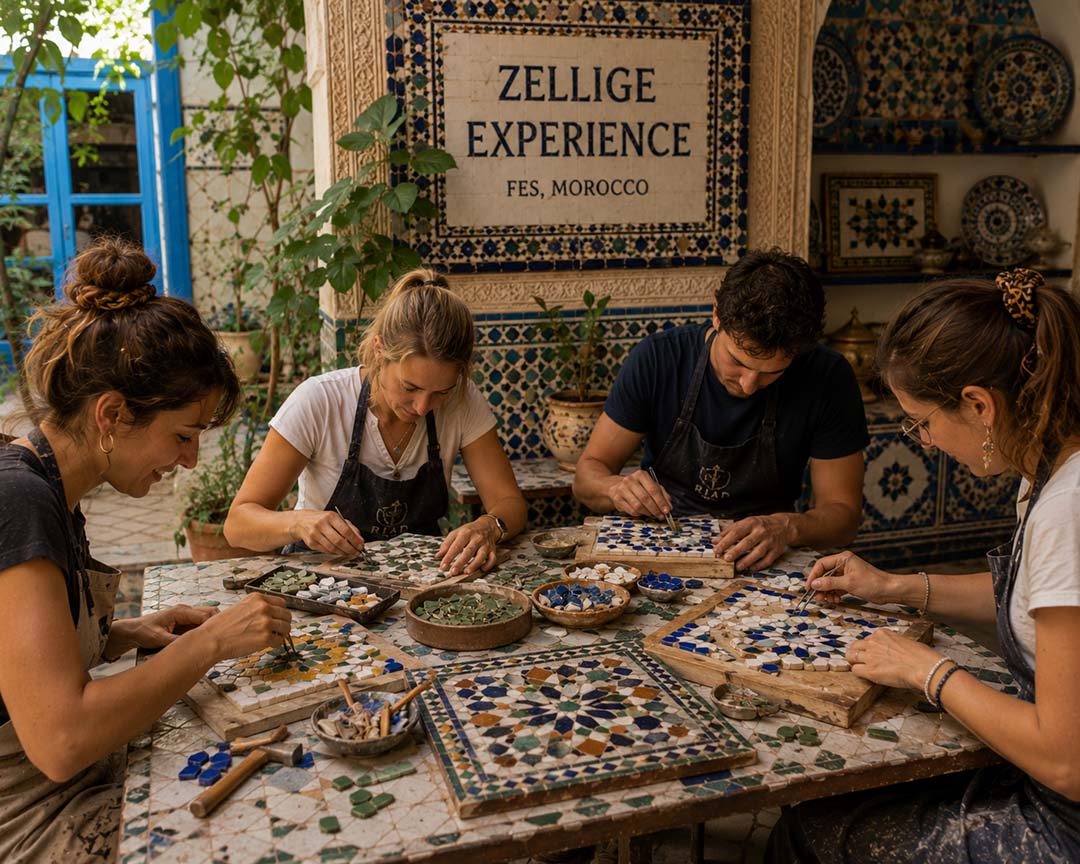
Zellige
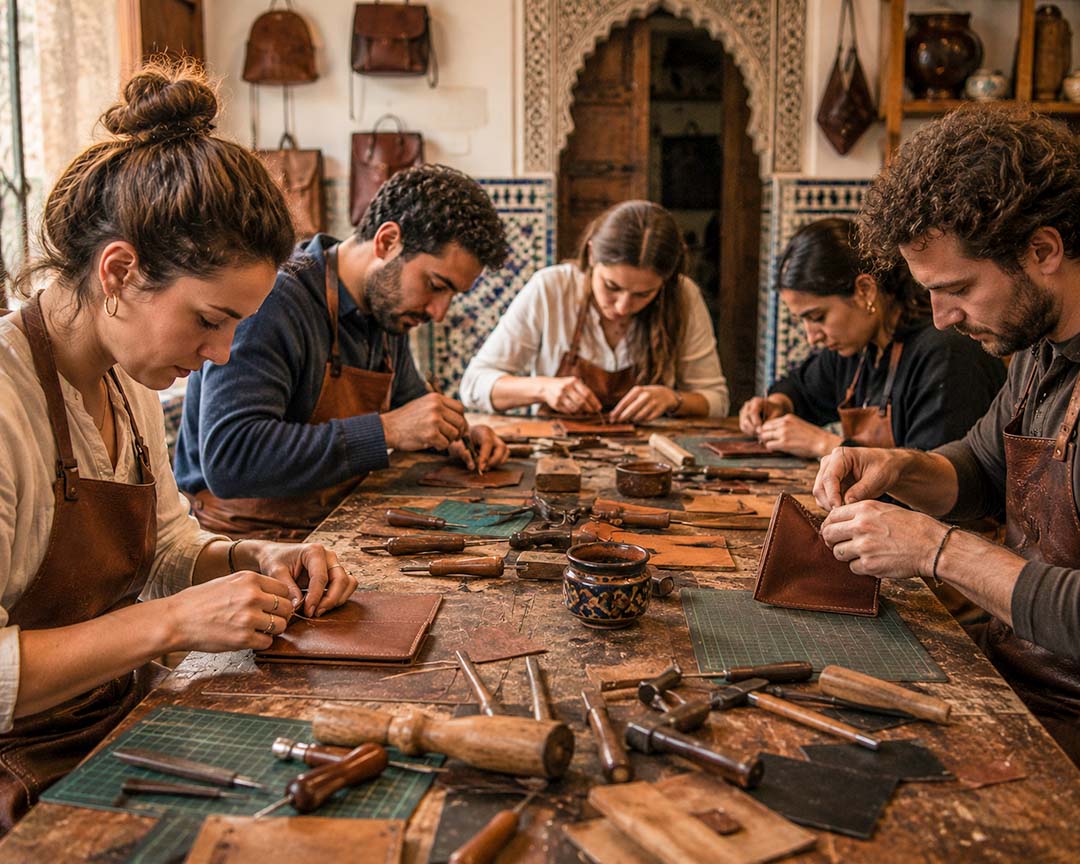
Leather
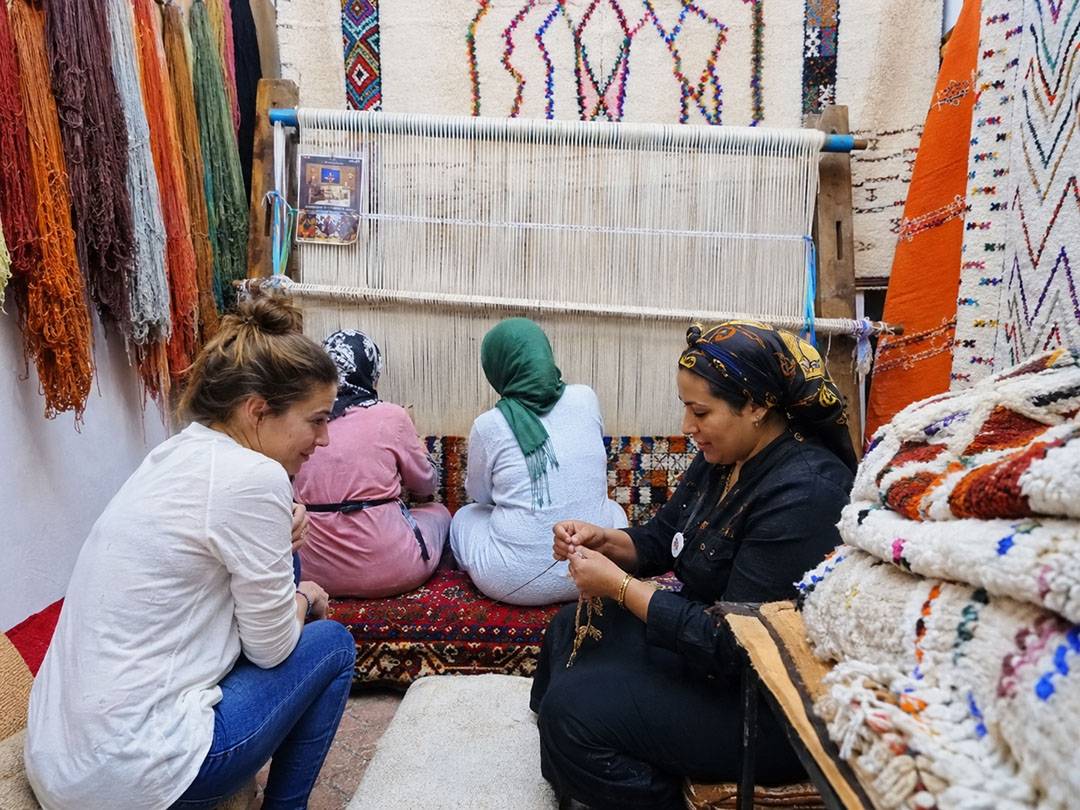
Weaving
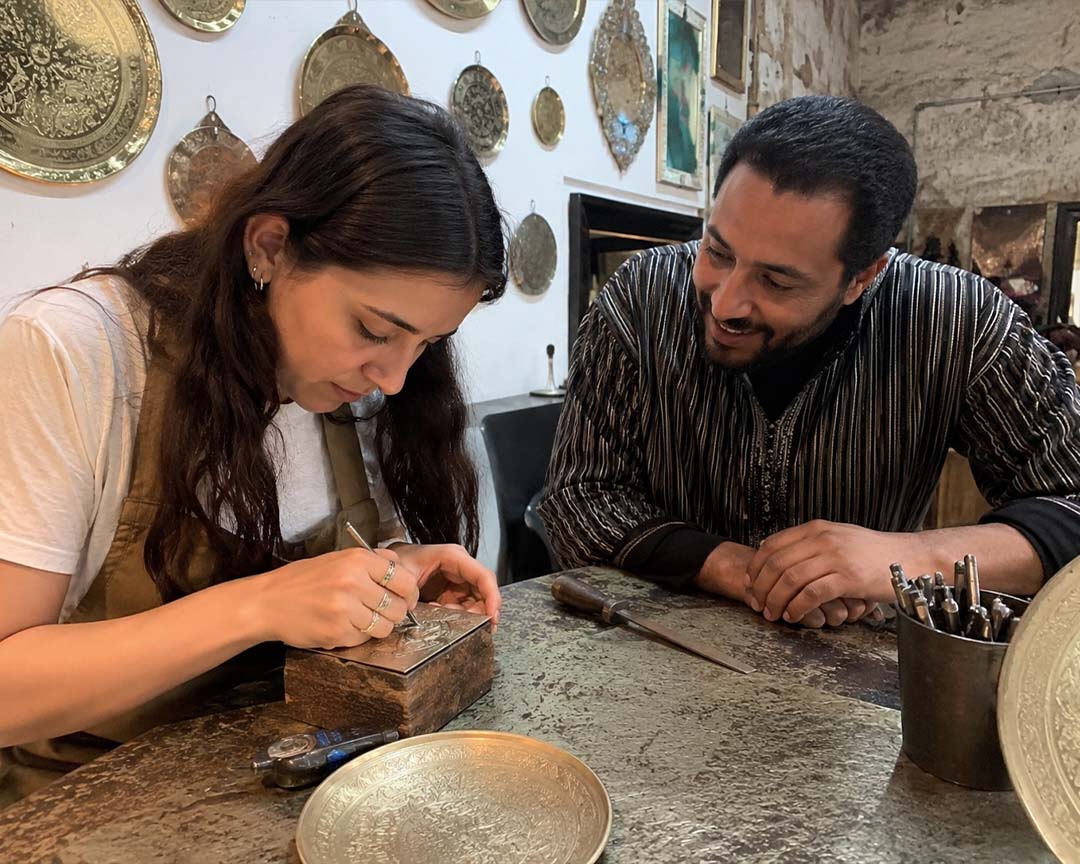
Brass
Walk through Fes and craftsmanship is never far away. You hear metal being tapped and engraved, see carpets hanging above narrow souk passages, pass shelves filled with hand-painted ceramics and discover walls covered in precisely arranged zellige. These objects are not simply decorations. They are part of a living culture shaped by generations of Moroccan artisans.
The traditional crafts of Fes include pottery, zellige mosaic, leatherwork, carpet weaving, brass engraving, embroidery and carved plaster. Each craft has its own materials, tools and techniques, yet they share something important: skill is developed through patience, repetition and direct learning from experienced craftspeople.
For travellers, Fes offers more than the opportunity to shop for handmade objects. It is also possible to enter a working atelier, observe the production process and try some of these techniques under the guidance of a local artisan. This guide introduces the city’s best-known crafts, explains how they are made and helps you choose a hands-on experience that matches your interests.
Fes or Fez? Both spellings refer to the same Moroccan city. “Fes” is widely used in Morocco, while “Fez” remains common in English-language travel searches and publications.
Explore this complete guide
Traditional crafts of Fes at a glance
| Craft | Main materials | Common handmade objects | Ideal for visitors interested in |
|---|---|---|---|
| Pottery | Clay, glaze and mineral pigments | Bowls, plates, tagines and decorative pieces | Ceramics, painting and hands-on creation |
| Zellige | Glazed terracotta tiles | Geometric mosaics, panels, tables and fountains | Geometry, design and Moroccan architecture |
| Leatherwork | Tanned leather, thread and metal fittings | Wallets, bags, belts, slippers and poufs | Practical objects and traditional hand-stitching |
| Weaving | Wool, cotton and other fibres | Carpets, blankets and small tapestries | Textiles, colour and pattern |
| Brass engraving | Brass and hand tools | Trays, plates and decorative objects | Detailed drawing and metalwork |
| Plaster carving | Gypsum plaster and carving tools | Decorative panels and architectural ornament | Moroccan interiors and relief design |
Why is Fes famous for traditional craftsmanship?
Fes has long been a centre of learning, trade and artisanal production. Its historic medina brought craftspeople, merchants, materials and customers together in a dense urban environment. Over time, particular areas became associated with specific trades. Even today, a walk through the old city reveals streets and souks where artisans continue to work close to the people who sell their finished pieces.
Craftsmanship is visible throughout Fes. It appears in the zellige covering fountains and courtyards, the carved plaster framing arches, the decorated woodwork inside traditional buildings, the brass trays used to serve tea and the ceramics found in Moroccan homes. This close relationship between craft, architecture and daily life is one reason Fes remains so important to Morocco’s cultural identity.
Many techniques are learned through practice rather than from written instructions. An apprentice watches how a master holds a tool, prepares a material or corrects a small imperfection. With time, individual movements become precise and consistent. The knowledge passed between generations includes not only how to make an object, but also how to judge the quality of clay, control a pattern, select leather or finish a surface.
This heritage is living rather than frozen in the past. Artisans preserve traditional methods while responding to new colours, forms and uses. A centuries-old technique may now be used to create a contemporary table, wall panel, handbag or decorative object. That balance between continuity and creativity makes the craft culture of Fes especially compelling.
Fes pottery and the celebrated Bleu de Fès
Pottery is among the most recognisable crafts associated with Fes. Traditional Fassi ceramics are particularly known for detailed decoration, balanced compositions and the deep blue designs often called Bleu de Fès. Floral forms, leaves, lines and geometric motifs are painted across plates, bowls, vases and tagines, transforming useful objects into decorative pieces.
Not every Moroccan ceramic is made in the same way or belongs to the same regional tradition. Pottery from Fes has its own visual identity, just as ceramic traditions from other parts of Morocco have distinctive colours, clays and forms. Understanding these differences makes visiting an atelier more meaningful: what first appears to be a simple bowl is the result of several specialised stages.
How is traditional Fes pottery made?
The process normally begins with clay that must be cleaned, prepared and kneaded to create a workable consistency. The artisan then shapes it by hand, with a mould or on a potter’s wheel. Using the wheel requires coordination: one movement keeps the clay centred while another gradually raises and shapes the walls of the object.
Once formed, the piece must dry carefully. If moisture leaves the clay unevenly or too quickly, cracks and deformation can occur. The dry object is then fired, creating a stronger ceramic body ready for the finishing stages.
Depending on the technique, the surface is prepared before an artisan adds decoration by hand. Painting a symmetrical design on a curved plate or bowl demands planning and control. A small error can disturb the rhythm of the entire composition. Glazing and a further firing develop the final surface and colours.
The complete process can therefore include:
- Preparing and kneading the clay
- Shaping the object by hand, mould or wheel
- Drying it gradually
- Completing the first firing
- Preparing and decorating the surface
- Applying the appropriate glaze
- Firing and inspecting the finished piece
Drying and firing mean that a wheel-thrown object may not always be ready to take away immediately. Visitors should ask their workshop in advance whether they will create a new clay object, decorate a prepared ceramic piece or combine several activities. They should also confirm whether a finished piece can be collected later or shipped.
What do visitors learn in a pottery workshop?
A beginner pottery workshop is not about producing a perfect object in a few minutes. Its value comes from feeling how clay responds to pressure and discovering how much control an experienced potter makes look effortless. Depending on the selected activity, participants may practise shaping clay, use a potter’s wheel, form a simple piece or paint Moroccan-inspired designs.
No previous experience is normally necessary for a beginner session, but the exact programme differs by workshop. Before booking, check the duration, included techniques and arrangements for finished ceramics.
Interested in working with clay? Explore our pottery workshops in Fes and choose between shaping, painting and more immersive ceramic experiences.
Moroccan zellige: the art of hand-cut mosaic
Zellige is one of the defining features of Moroccan design. It is made from small pieces of glazed tile cut into precise shapes and assembled into geometric compositions. The finished mosaic may cover a fountain, wall, floor, table or architectural element, but its beauty begins with many individual pieces that must fit together accurately.
Unlike a printed tile that reproduces a complete design on one surface, traditional zellige is a constructed mosaic. Stars, crosses, polygons and other forms are combined through repetition and symmetry. The design can appear endlessly complex, yet it grows from a system of carefully related shapes.
How are zellige mosaics made?
The process begins with clay tiles. After forming, drying and firing, their visible surfaces receive coloured glaze. The artisan then marks and cuts the tiles into smaller geometric components. This stage requires confidence and accuracy: each shape must work not only alone, but as part of the larger pattern.
The cut pieces are arranged face down according to the chosen composition. Working from the reverse means the artisan must understand the pattern even when the finished surface is hidden. Once the layout is complete, the pieces are secured to form a stable panel or object. When it is turned over, the full design is finally revealed.
In simplified form, the main stages are:
- Forming and drying the clay tiles
- Firing and glazing their surfaces
- Marking the required shapes
- Cutting each component by hand
- Arranging the pieces into a geometric pattern
- Securing and finishing the mosaic
Why is geometry so important in zellige?
Geometric construction gives zellige its visual order. Repeated shapes create rhythm, while symmetry allows a composition to expand beyond a single centre. Colour introduces contrast and helps reveal the structure of the pattern. The result is both mathematical and expressive: strict relationships between shapes can generate an extraordinary variety of designs.
Visitors can see zellige across Fes in traditional houses, riads, madrasas, fountains and other historic buildings. Observing it after trying to assemble a small mosaic changes the experience. Details that once seemed purely decorative begin to reveal planning, measurement and patient manual work.
What happens in a zellige workshop?
During a hands-on session, an artisan can introduce the materials, traditional tools and logic of Moroccan mosaic. Participants may learn how the pieces are shaped, select a composition and assemble a small design. Beginner projects are adapted so that visitors can experience the technique safely without requiring years of training.
Discover the craft behind Morocco’s geometric mosaics in a zellige workshop in Fes.
Leather craftsmanship in Fes
Fes is internationally associated with leather, and the city’s historic tanneries are among its most photographed places. Yet tanning is only one part of the story. Once a hide has been prepared, skilled leatherworkers cut, stitch and finish it to create bags, wallets, belts, slippers, poufs and other objects.
The journey from raw material to finished product involves several types of expertise. Leather must be prepared, tanned, coloured and dried before a craftsperson selects the appropriate section for an object. The artisan then works with patterns, cutting tools, thread, needles and fittings. Good construction matters as much as appearance: a bag or wallet should open, fold and carry weight without weak seams or poorly finished edges.
How can you recognise careful leatherwork?
When examining a handmade leather object, look beyond colour and softness. Check whether the stitching is secure and reasonably consistent, especially around corners and handles. Inspect edges, lining, closures and metal fittings. Natural variation in leather is not automatically a defect; it can be part of the material’s character. Large cracks, weak seams or careless finishing, however, may affect durability.
It is also useful to ask direct questions: What type of leather was used? Where was the piece made? Which stages were completed by hand? A trustworthy workshop or seller should be able to explain the object rather than relying only on a sales pitch.
What can you make in a leather workshop?
A small wallet is a practical introduction to measuring, cutting, punching and stitching. A leather bag is a more substantial project that generally requires additional time and more construction steps. The artisan prepares a programme that allows beginners to participate while receiving help with difficult or safety-sensitive tasks.
Travellers who are more interested in shopping than making can also benefit from visiting workshops with someone who understands leather quality and local production. The objective should be informed, pressure-free purchasing—not simply moving visitors from one shop to another.
Choose a leather wallet workshop, a leather bag-making workshop or a guided leather shopping experience in Fes.
Carpet and tapestry weaving in Fes
Weaving transforms individual threads into a strong and expressive surface. Moroccan textile traditions include many regional and community-specific techniques, motifs and materials, so it is important not to describe every Moroccan carpet as belonging to one identical style. Fes is both a place of production and an important centre where textiles from different traditions are encountered, appreciated and sold.
A loom holds the vertical warp threads under tension. The artisan passes or knots other fibres through this structure, gradually building the textile. Colour changes, repeated forms and differences in texture emerge row by row. Large carpets can require considerable time, which explains why genuine handwoven pieces cannot be evaluated only by their dimensions.
What does weaving involve?
Although methods differ, the work may include:
- Preparing the loom
- Arranging and tensioning the warp
- Selecting fibres and colours
- Weaving or knotting the design
- Compressing and checking each section
- Finishing the edges and removing the textile from the loom
The maker must maintain tension while following the composition. A slight change repeated across many rows can alter the entire object. This combination of technical discipline and creative choice makes weaving particularly absorbing to watch and practise.
Can a beginner try carpet weaving?
A visitor will not complete a large handmade carpet during a short holiday workshop. A small tapestry, however, can introduce the basic relationship between warp, weft, tension, colour and pattern. Longer workshops offer more time to understand the loom and develop a personal design.
Explore a carpet weaving workshop, create a smaller piece in a tapestry weaving workshop, or learn about the process during a carpet weaving tour.
Brass engraving and metalwork in Fes
Metalwork contributes a distinctive soundtrack to the old city. In areas associated with coppersmiths and metal artisans, repeated tapping signals that trays, vessels and decorative pieces are still being shaped, repaired or engraved by hand.
Brass engraving begins with a design suited to the form of the object. The artisan may mark guiding lines before using specialised hand tools to press or cut patterns into the surface. Pressure, angle and spacing must remain controlled. The design becomes visible through many small, deliberate marks rather than one dramatic movement.
Common decoration includes geometric borders, floral forms and repeating motifs. Once the engraving is complete, the surface can be cleaned and polished to emphasise the contrast between lines, textures and reflective areas.
Is brass engraving suitable for beginners?
Beginners can practise a simplified motif under close guidance. The experience teaches participants how to transfer a design, hold the tool and build a pattern progressively. Because the activity involves metal tools, visitors should follow the artisan’s instructions and confirm any age requirements before booking for children.
Try this detailed traditional technique in a brass engraving workshop in Fes and create a personalised decorative piece.
Other crafts worth discovering in Fes
Pottery, zellige, leather, weaving and brass are only part of the city’s artisan landscape. Several other skills help create the interiors, clothing and objects associated with Moroccan culture.
Plaster carving, or gebs
Carved plaster is visible in the refined architectural decoration of Moroccan riads, madrasas and traditional houses. The material is prepared as a smooth surface and then carved to create geometric, floral or calligraphic relief. The work demands careful timing and control: the surface must be suitable for carving, and the artisan must create depth without damaging delicate sections.
A beginner plaster carving workshop in Fes offers a closer look at patterns that travellers often admire on walls without knowing how they were produced.
Embroidery and textile decoration
Embroidery adds pattern and texture to clothing and household textiles. Fine handwork requires steady tension, consistent stitches and a clear understanding of the composition. A workshop can introduce traditional inspiration while allowing participants to create a small personal design.
Pottery painting
Pottery painting is different from forming clay on a wheel. Participants decorate a prepared ceramic object, concentrating on colour, line and Moroccan-inspired motifs. It can be a suitable option for travellers who are especially interested in surface design or who prefer a less physically demanding activity.
Watching an artisan versus joining a hands-on workshop
Visiting a working atelier and joining a workshop are both valuable, but they create different experiences.
| Experience | Artisan demonstration or tour | Hands-on workshop |
|---|---|---|
| Main activity | Watching and asking questions | Learning by making |
| Time required | Usually shorter | Often two hours or more |
| Interaction | General introduction | More direct guidance |
| Understanding | Overview of several stages | Practical insight into selected techniques |
| Finished object | Usually not included | May include a participant-made piece |
| Best suited to | Travellers with limited time | Visitors seeking deeper cultural participation |
A demonstration is ideal when you want to see several crafts or understand a full production process that cannot be completed during one visit. A hands-on workshop is better when you want to slow down, speak with an artisan and understand a technique through your own movements.
When choosing, read the programme carefully. The word “workshop” should mean meaningful participation, but the amount of hands-on time can differ between providers. Ask what you will personally do, how long the practical activity lasts and what object, if any, you will complete.
Which craft workshop in Fes should you choose?
The best experience depends on your interests, available time and the type of object you would like to make.
- Choose pottery if you want to work directly with clay or explore ceramic decoration.
- Choose zellige if you enjoy geometry, architecture and precise pattern-making.
- Choose leatherwork if you want to create a practical object such as a wallet or bag.
- Choose weaving if you prefer textiles, colour and a slower, repetitive creative process.
- Choose brass engraving if you enjoy drawing, detail and working with hand tools.
- Choose plaster carving if Moroccan architecture and relief decoration fascinate you.
Families may prefer a beginner-friendly pottery painting, mosaic or small craft project, depending on the children’s ages. Couples can work on individual pieces or share a creative activity. Solo travellers often find workshops especially rewarding because the structured setting provides a natural way to meet local people and ask questions.
Always confirm minimum ages and supervision requirements directly with the organiser. Suitability depends on the tools, materials and specific programme—not only the name of the craft.
Practical tips before booking an artisan workshop
Book ahead when possible
Artisan workshops are not always large tourism venues with unlimited daily capacity. Advance booking gives the organiser time to coordinate the artisan, prepare materials and confirm the appropriate language. It is particularly important for private sessions, families and larger groups.
Ask what is included
Check the duration, materials, instruction, refreshments, meeting point and any transportation arrangements. If you will make an object, ask whether you can take it immediately or whether it needs drying, firing or additional finishing.
Wear practical clothing
Choose comfortable clothes that allow you to sit and move easily. Clay, pigments, metal dust and other workshop materials can mark delicate clothing. Closed shoes may be preferable in production areas.
Explain your needs in advance
Tell the organiser about children, mobility requirements, allergies or any difficulty using particular tools. Traditional ateliers can have steps, narrow entrances or working surfaces designed for artisans rather than visitors, so accessibility should be confirmed rather than assumed.
Respect the working environment
Ask before photographing artisans, tools or other visitors. Listen to safety instructions and remember that an atelier may be both a visitor experience and someone’s everyday workplace.
How craft experiences can support local artisans
Buying directly from makers and paying fairly for skilled instruction can contribute to the continuation of traditional crafts. A workshop gives an artisan another way to earn from specialist knowledge, not only from the sale of finished objects. It also helps visitors understand why handmade work requires more time—and often costs more—than mass-produced decoration.
Responsible participation should be based on respect. Artisans should be presented as skilled professionals rather than as background scenery. Visitors, in turn, deserve clarity about who is teaching, what they will do and how their payment relates to the experience.
The most meaningful cultural exchange happens when both sides have time to communicate. Asking how a technique was learned, how long an object takes to make or how designs are selected often leads to a richer conversation than focusing only on the final price.
How to buy authentic handmade crafts in Fes
Handmade does not mean mechanically perfect. Small differences in shape, brushwork, colour or texture can reveal the human process behind an object. However, natural variation should not be confused with poor construction.
Before buying, inspect the piece and ask:
- Who made it and where was it produced?
- Which stages were completed by hand?
- What materials were used?
- Is a ceramic object decorative or suitable for food use?
- Are seams, handles and closures strong?
- Can a fragile item be packed safely for air travel?
- Is shipping available, and what does it include?
For pottery and zellige, look for cracks or significant damage and ask about intended use. For leather, examine stitching, edges and fittings. For carpets, ask about fibres, technique, dimensions and origin. For engraved metal, inspect the consistency and finish of the design.
If you plan to carry fragile work home, use layers of protective material and place the object where it cannot move inside your luggage. Keep particularly valuable or delicate pieces in your hand luggage if airline security and baggage rules permit. For large purchases or international shipping, request written information about price, packaging, delivery and responsibility for damage.
Experience the living crafts of Fes
The traditional crafts of Fes are not only objects to photograph or souvenirs to purchase. They represent accumulated knowledge: how to centre clay, divide a geometric pattern, judge a piece of leather, control tension on a loom or guide an engraving tool across metal.
Watching a skilled artisan reveals the precision behind that knowledge. Trying the craft yourself reveals something more—the patience it demands. Even a small bowl, mosaic, wallet, tapestry or engraved motif can create a lasting connection to the people and traditions of the city.
Whether you have two hours or several days, a hands-on experience can add a deeper dimension to your time in Fes. Instead of leaving only with photographs, you leave with a better understanding of how Moroccan craft is made and why it continues to matter.
Frequently asked questions about traditional crafts in Fes
What traditional crafts is Fes famous for?
Fes is particularly known for hand-painted pottery, zellige mosaic, leatherwork, carpet and tapestry weaving, brass and copper work, carved plaster, woodwork and embroidery. These crafts are visible in the city’s architecture, souks, working ateliers and everyday objects.
What is Bleu de Fès pottery?
Bleu de Fès refers to the distinctive blue decoration strongly associated with traditional ceramics from Fes. Artisans use blue designs—often combined with floral or geometric inspiration—to decorate bowls, plates, tagines, vases and architectural pieces.
What is the difference between pottery and zellige?
Pottery involves shaping clay into objects such as bowls, plates or tagines. Zellige uses glazed clay tiles that are cut into small geometric shapes and assembled into mosaics. Both begin with clay, but their techniques and final uses are different.
Is Moroccan zellige still made by hand?
Traditional Moroccan zellige is still produced through several manual stages, including forming and glazing tiles, cutting individual shapes and arranging them into geometric compositions. Production methods can vary, so visitors should ask an atelier to explain its process.
Can tourists join craft workshops in Fes?
Yes. Visitors can participate in beginner-friendly pottery, zellige, leather, weaving, brass engraving, plaster carving and other workshops in Fes. The amount of hands-on participation, duration and included materials vary, so compare the programme before booking.
Do I need previous craft experience?
Most visitor workshops are designed for beginners and do not require previous experience. The artisan demonstrates the essential technique and assists with difficult stages. Advanced or multi-day programmes may offer more independence and complexity.
How long does a craft workshop in Fes take?
Many introductory workshops last approximately two to four hours, while complex projects and immersive courses can take longer. Check the individual experience because a small pottery painting session and a handmade leather bag workshop do not require the same amount of time.
Are artisan workshops suitable for children?
Some workshops are suitable for families, but the appropriate minimum age depends on the activity, tools and level of supervision. Pottery painting and simplified mosaic projects may be easier for younger participants than activities involving sharp or heavy tools. Confirm requirements before booking.
Can I take my handmade creation home?
It depends on the craft. A leather, weaving, mosaic or engraved item may be ready at the end of the session. Fresh pottery can require drying, glazing and firing before collection or shipment. Ask the organiser what is included and when the object will be available.
Should I book a workshop in advance?
Advance booking is recommended because artisans, materials and language support may need to be arranged. Booking early is particularly helpful for families, private sessions, larger groups and travellers with limited time in Fes.
—
Experience the craft—not just the souvenir
Meet local artisans, learn traditional techniques and create something meaningful with your own hands.